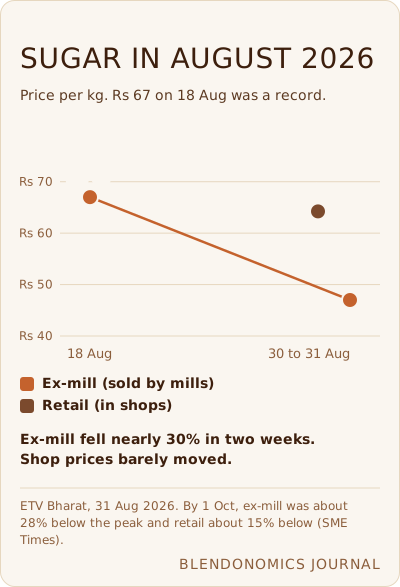
On 18 August 2026, ex-mill sugar hit Rs 67 a kilo. A record.
By 31 August, it was Rs 47. Down nearly 30 percent in two weeks.
In the shops, it moved much slower. On 30 August, retail sugar was still Rs 64.23 a kilo.
Why it spiked
India's 2025-26 sugar output estimate was cut from 343 lakh tonnes to 306. Some of that cane goes to ethanol, not sugar. After that, the sugar left for the market was close to, or slightly below, what India eats in a year: about 280 to 285 lakh tonnes.
When supply and demand sit that close, small shocks move prices a lot.
What the government did
1. Let mills sell sugar refined for export inside India, about 3 to 3.5 lakh tonnes over two months.
2. Opened imports.
3. From 1 September, limited bulk users to 15 days of stock.
4. From 15 October to 30 November, limited dealers to 1,000 quintals of stock and 15 days of holding (2,000 quintals in Kolkata and Assam).
By 1 October, the government said ex-mill prices were down about 28 percent from the peak and had held steady for three weeks. Retail was down about 15 percent from the August high.
What comes next
The 2026-27 season starts now. The early forecasts are tight.
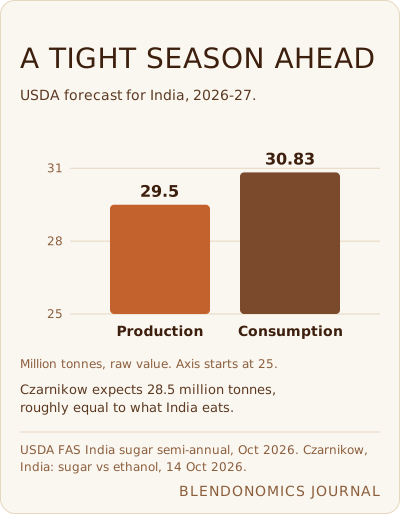
The USDA forecasts India's sugar output down 14 percent to 29.5 million tonnes, against consumption of about 30.8 million tonnes. Czarnikow, a sugar trader, expects 28.5 million tonnes, roughly equal to consumption. Opening stocks are low.
The government is expected to stop cane going to ethanol this season, which would keep more sugar in the market. As of mid-October, that was expected, not notified.
So read it this way: tight, but watched. The government has shown it will step in. Expect swings, not a steady climb.
Sugar is in almost everything a cafe sells. When it moves, the whole menu moves.
What this means for your menu
Sugar is in your drinks, your syrups, your bakes, your sauces and your premixes. A sugar move does not hit one item. It hits all of them at once.
1. Do not reprice on every spike. August's spike reversed in two weeks. A price rise is remembered long after the reason is gone. In one well-known study, 71 percent of people called a price increase unfair.
2. Keep a buffer in your food cost. If a drink only works at today's sugar price, it is priced too close to the edge.
3. If you must raise prices, do it once. Across the menu, with something added, like a bigger size or a better version. Not item by item, month by month.
4. Ask your suppliers how they handle input swings. Do they hold prices for a period? How much notice do they give?
5. Watch two dates. The ethanol decision around November, and the first crushing numbers of the season.
Sources
- ETV Bharat, ex-mill sugar prices fall nearly 30 percent to Rs 47 per kg (18 and 31 August figures, retail Rs 64.23)
- SME Times, retail sugar prices down 15 percent, ex-mill down about 28 percent (1 October 2026)
- USDA FAS, India sugar semi-annual report, October 2026
- Czarnikow, India: sugar vs ethanol, 14 October 2026
- PIB, India's sugar industry, August 2026
- Kahneman, Knetsch and Thaler, fairness as a constraint on profit seeking, 1986
Keep reading
Why Your New Menu Item Flops Before Anyone Tastes It
Most new drinks do not fail on taste. They fail on a price nobody was willing to test. A pricing method for any new item, using hot chocolate as the example.
The Milk Line: Which Drinks Sell in Indian Cafes, and Why Habit Beats Weather
Habit decides who buys a drink in India. Weather decides when. The milk line, the model behind it and what 59 cafe accounts say, in one place.
What Is a Coffee Blend? 80/20, 70/30 and House Blend Explained
80/20 is not a grade. It is a recipe: 80 parts Arabica, 20 parts Robusta. What a blend is, what each bean adds, and why roasters make one.