MATCHA
COLD
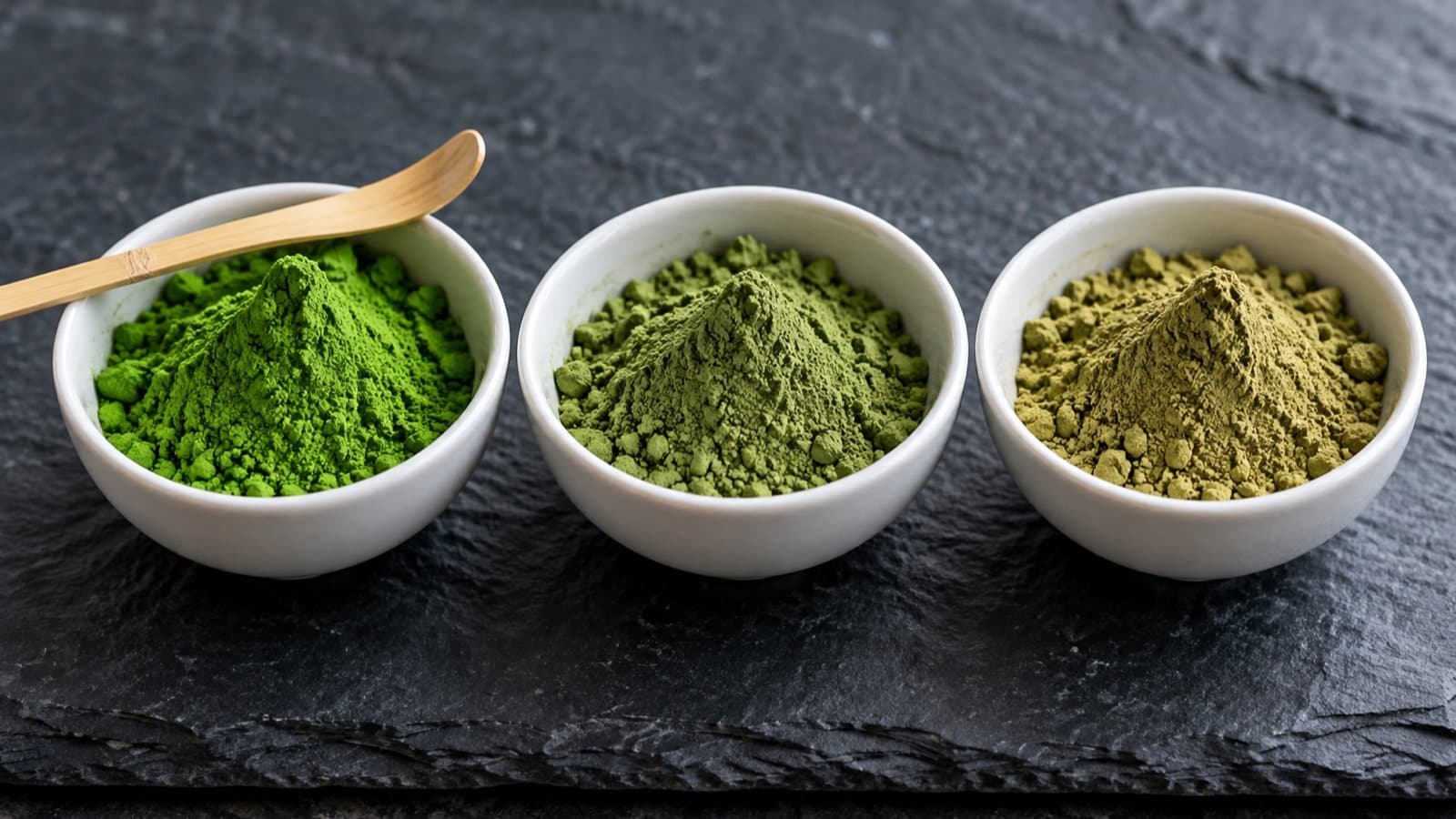
Ceremonial. Premium. Culinary. It is like buying kesar because the packet says "pure". The word tells you very little. The colour, the smell and the price per gram tell you a lot more.
Most cafes buy matcha by the word on the pack. This guide shows a cafe owner which grade to buy for milk drinks, how to check a powder before you order, and what 100 g costs in India.
No. In Japan, "ceremonial grade" is not an official or regulated class (Ikkyu Tea, a Japanese matcha seller). Western brands made the term popular to separate matcha for drinking from matcha for cooking.
So the grade on the pack is the seller's word. It is a starting point. The powder in your hand is the proof.
Three words, three jobs. Ceremonial is meant to be whisked with hot water and drunk plain. It is usually made from the youngest, most tender leaf. Culinary is made from slightly older leaf, tastes stronger and more astringent, and is meant for lattes, smoothies and baking (Ikkyu Tea, Chowhound).
"Premium culinary" or "latte grade" sits between them. That is a seller's word too, and it means a matcha made to mix with milk without tasting thin.
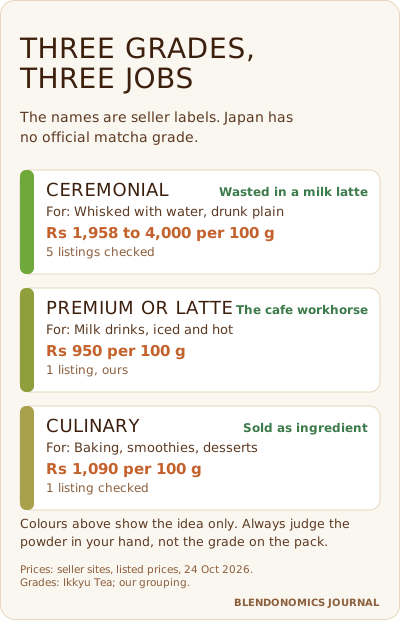
Culinary or latte grade. Our read: ceremonial in a latte is money poured into milk.
Here is the sum. A latte uses about 2.5 to 3 g of matcha (supplier guides, see our matcha and ube article, which also covers why milk hides the grade). At the ceremonial prices in the table below, that is Rs 49 to 120 of matcha a cup. At culinary prices it is Rs 24 to 33, so ceremonial costs Rs 25 to 87 more per cup (our arithmetic).
Taste both in your own milk before you decide.
You can check most of it without tasting. Colour, smell and the label take two minutes. Ask the seller for a sample and run the seven checks.
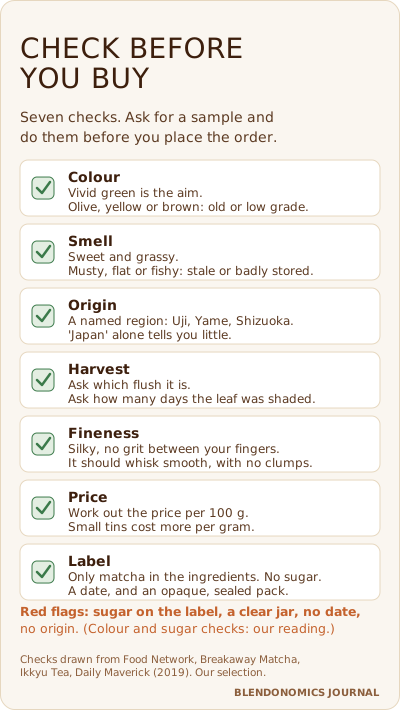
Three points need more words.
Also ask for the pack date and how it is packed. Sources recommend an opaque, airtight pack, and one expert says to skip matcha sold in clear jars on a bright shelf (Food Network).
Compare per 100 g. A 30 g tin always looks cheaper than a 100 g pouch, and it is not.
| Matcha (as labelled) | Pack | Listed price | Per 100 g |
|---|---|---|---|
| Blendonomics Premium Culinary | 100 g | Rs 950 | Rs 950 |
| Kissaten Culinary | 100 g | Rs 1,090 | Rs 1,090 |
| Tencha Ceremonial, Classic Grade | 50 g | Rs 979 | Rs 1,958 |
| Kissaten Ceremonial, Uji | 100 g | Rs 2,290 | Rs 2,290 |
| Kissaten Ceremonial, Uji | 30 g | Rs 1,090 | Rs 3,633 |
| Vahdam Ceremonial | 30 g | Rs 1,199 | Rs 3,997 |
| Bree Ceremonial | 30 g | Rs 1,200 | Rs 4,000 |
The gap is wide. Ceremonial lists at roughly two to four times the culinary price per 100 g. These are list prices before shipping and offers, and they change. Check the page on the day you buy.
A high price proves nothing. Rs 4,000 a 100 g can still be dull olive in the tin. Run the seven checks.
We should be honest here. Of the 105 accounts that bought from us since July 2025, 4 bought matcha. None ordered it a second time. Matcha was 0.2% of cafe and restaurant order value.
That says nothing about which grade is better. It says matcha is a drink people try and many cafes do not reorder. Our map shows where our sales team and partners reached, not all of India's demand. How to run a first test is in our matcha and ube article.
Cold, dark and sealed. Light, heat and air dull the colour and the taste. Sources recommend an opaque, airtight tin, kept in the fridge once opened, and used within about 1 to 2 months (Breakaway Matcha). Some sources say longer, but past peak.
Let the tin warm to room temperature before you open it. Condensation on cold powder is the main storage risk (Breakaway Matcha, and a storage guide on dev.to).
The sum matters here. At 3 matcha lattes a day, a 100 g pack is gone in about 12 days. At one a day it lasts a month. Buy the size you will finish while it is fresh.
Our Premium Culinary matcha is stone-ground tencha from Shizuoka, Japan, made for milk drinks: Rs 450 for 50 g, Rs 950 for 100 g. The matcha sampler lets you taste it in your own milk before you order more.
The grade is a label. The powder is the fact. What does yours look like when you open the tin?
 Should you add matcha?How to Start Selling Matcha in a Cafe: Cost Per Cup, Grade and an 8 Week Test5 min read →
 The matcha seriesMatcha Has No History in India. That Is Its Edge and Its Risk.6 min read →
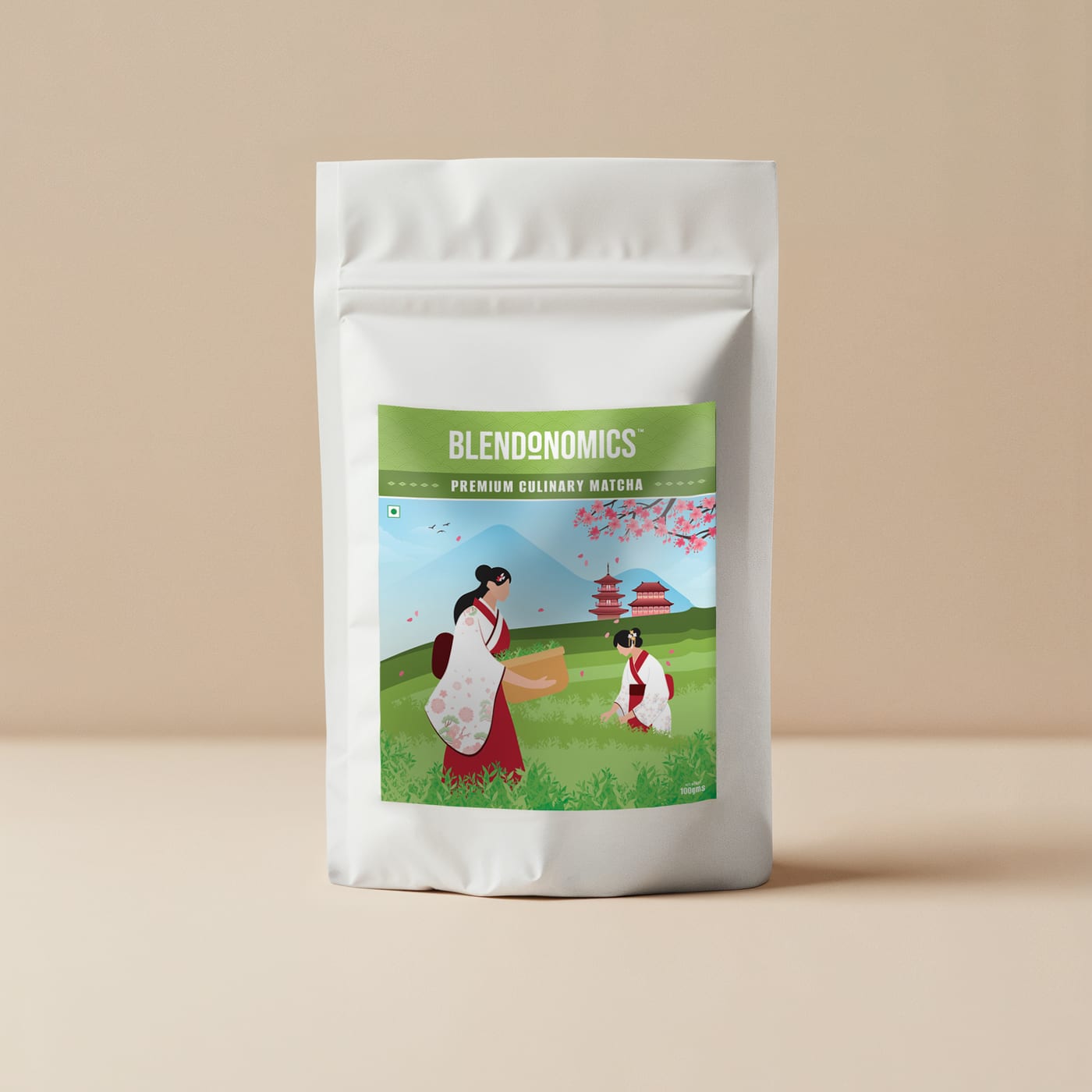 MatchaPremium Culinary MatchaLatte grade, made for milk drinksView product →Sample kitPremium Culinary MatchaPremium Culinary Grade MatchaView product →
Supplying a cafe? Request a sample kit →
Matcha searches in India are up five times since 2021. Four cafe accounts bought it from us and none came back. What to do before you add it.
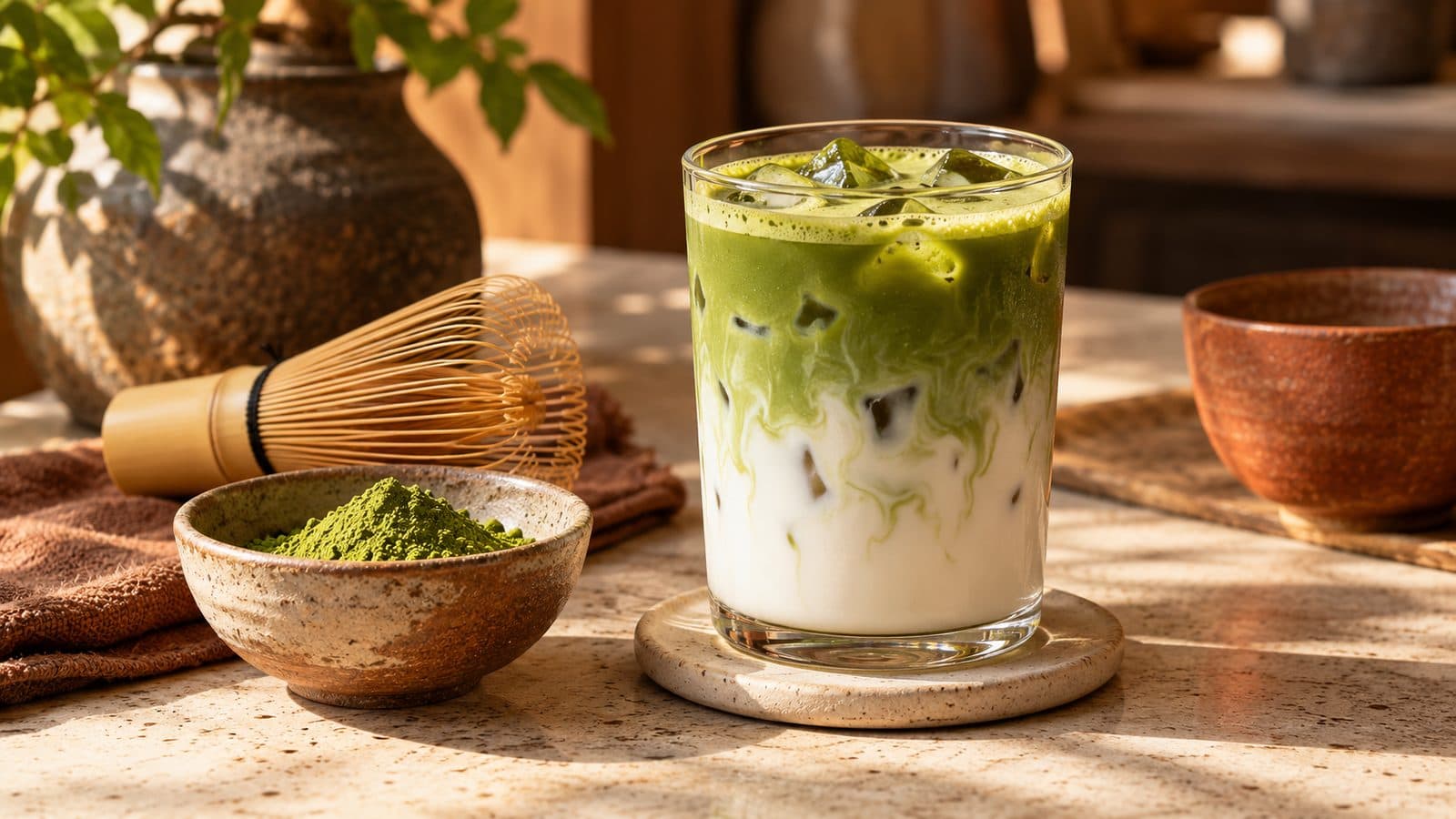
No childhood habit, no price anchor, no regional heartland. What that means for a cafe putting matcha on the menu. Part 3 of our weather vs preference series.
Habit decides who buys a drink in India. Weather decides when. The milk line, the model behind it and what 59 cafe accounts say, in one place.