SOURCING
Monsooned Malabar Coffee History: Sailing Ships, Suez and a Taste Europe Missed
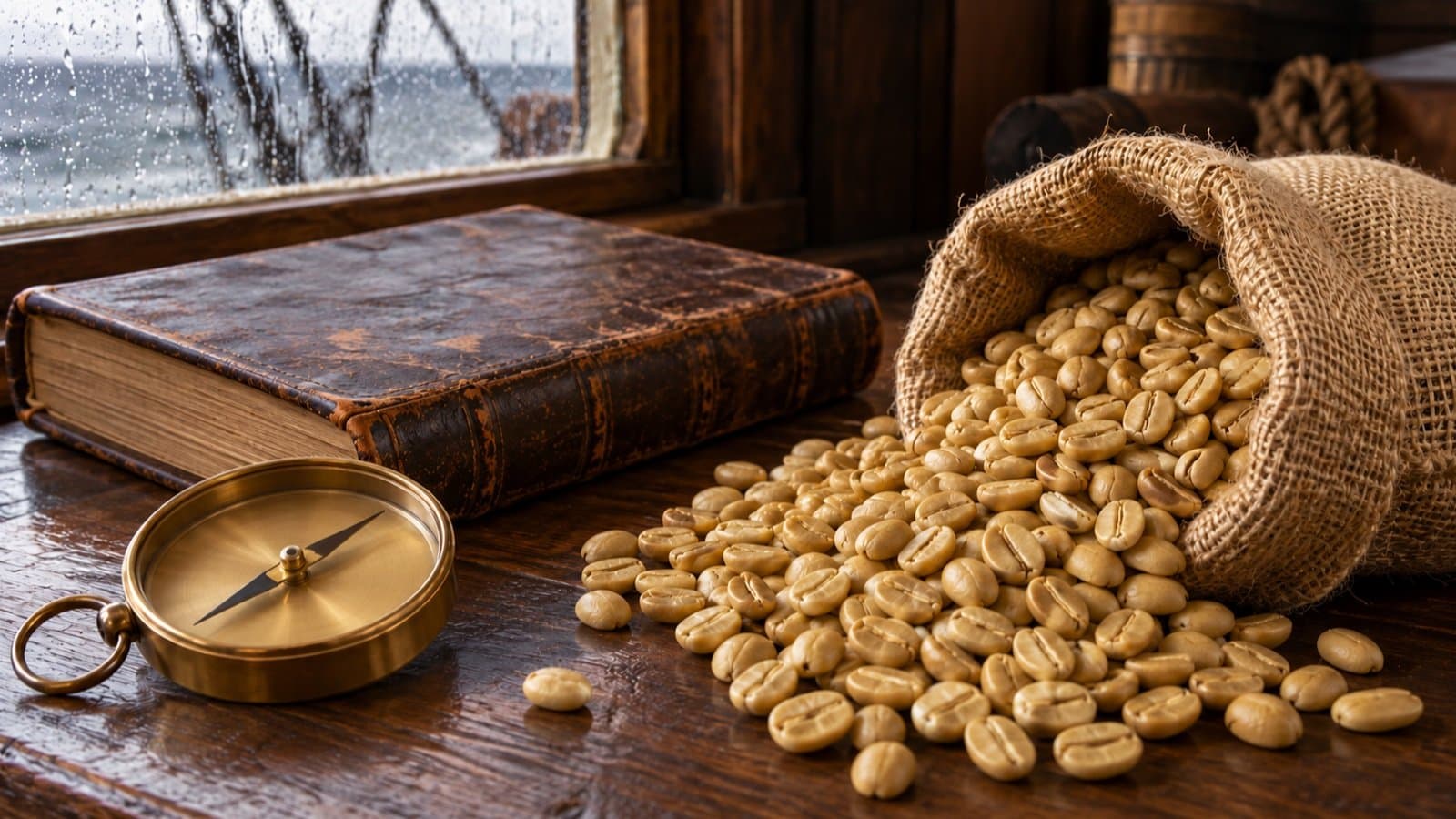
Monsoon Malabar began as a ruined cargo, the story goes. Four to six months in a damp hold, round the Cape of Good Hope. Europe liked the pale, swollen beans anyway.
It is the story most roasters tell. We went looking for the paper trail and found much less than we expected.
How did Monsoon Malabar begin? Half of the answer is record and half is legend. A cafe that sells it should tell customers the true half. Here is which is which.
Where did Monsooned Malabar come from?
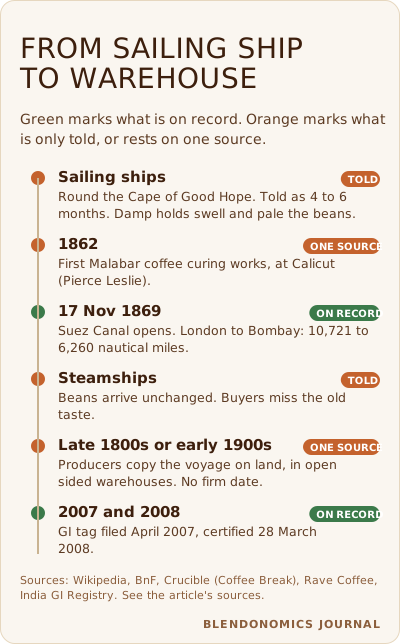
Coffee left India for Europe in wooden sailing ships. They went the long way, round the Cape of Good Hope. Sources put the trip at 4 to 6 months, though the French national library gives 2 to 3 months for a Marseille to Bombay run in the early 1870s. We do not pick one. The Coffee Board's own page says only "centuries ago", and other sources say the 19th century. We do not pick a date either.
The cargo sat low in the ship, in warm and wet air. The beans took on moisture, swelled, paled and lost their sharp acidity. Buyers in northern Europe came to expect that cup.
Here is the twist: the taste was never designed. It was a side effect of the route. The process we now call monsooning is the coast copying the side effect.
Did the Suez Canal really change the taste?
The Suez Canal opened on 17 November 1869. That part is firm.
It cut London to Bombay by about 40 percent (our arithmetic), from 10,721 nautical miles round the Cape to 6,260 through the canal. It also favoured steam. The canal's winds were poor for sail. Fewer sailing ships meant fewer damp months at sea.
Here is where the story goes soft. Roasters and importers say the beans then arrived green and unchanged, buyers missed the old cup, and the coast began to recreate it. We found no dated buyer complaint. We found no ledger. One roaster puts land monsooning in the late 19th or early 20th century. Most sources give no date.
One thing is on record. A coffee writer says Pierce Leslie opened the first curing works on the Malabar coast, at Calicut, in 1862, seven years before the canal. Curing works were already there. Our read: the canal may have sped up the shift, but the sources do not show it caused it.
| Claim | Status |
|---|---|
| Suez Canal opened 17 November 1869 | On record |
| London to Bombay 10,721 to 6,260 nautical miles | On record (BnF) |
| Voyage took 4 to 6 months | Sources differ |
| Sea air changed the beans | Told, no ship's record |
| Europe missed the old taste | Told, no buyer's letter |
| First Malabar curing works, Calicut, 1862 | One source |
| GI filed 2007, certificate 2008 | On record |
How is Monsooned Malabar made today?
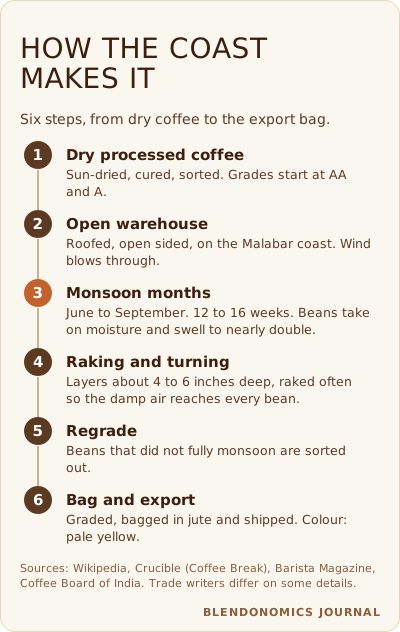
The coast now does on land what the ship once did by accident. These are the steps, from the Coffee Board's own page and the trade writing we found.
- Dry processed cherry is sun-dried, cured and sorted. The Coffee Board says only dry processed Arabica and Robusta are used. Trade grades start at AA and A.
- The beans wait until the monsoon, then go into open, roofed warehouses with the wind blowing through.
- From June to September they are spread in layers about 4 to 6 inches deep, and raked and turned often.
- Over 12 to 16 weeks (the Coffee Board's figure) the beans take on moisture, swell to nearly twice their size and fade to pale yellow.
- Some producers bag them into windrows so the wind passes between the sacks.
- The beans are graded again, fully monsooned beans are separated out, then they are bagged for export.
One trade writer puts exposure at 3 to 4 months, not 12 to 16 weeks. That is the same stretch of the monsoon, counted two ways.
Why are monsooned beans yellow, and is the cup low in acid?
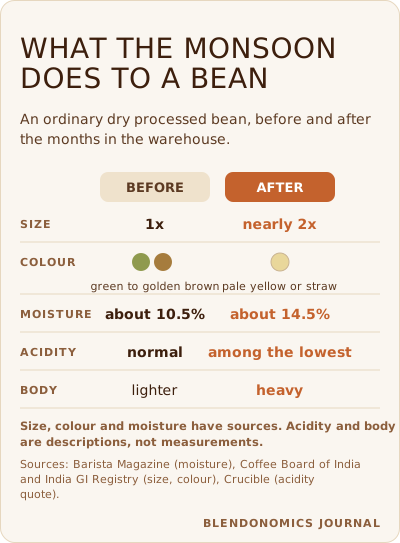
Look at the bean first. It swells to nearly double. It goes from green or golden brown to pale yellow, because it has soaked up months of damp air. It holds more water too: about 14.5 percent after monsooning against about 10.5 percent for ordinary Indian coffee, per Barista Magazine.
Then the cup. The Coffee Board calls it mellowed and heavy, and says the trade uses it to soften more acidic coffees. Menu use is in our earlier article.
What does the GI tag cover?
The Coffee Board filed for Monsooned Malabar Arabica Coffee in April 2007. The registry shows the certificate dated 28 March 2008. The Robusta version was filed in October 2007 and certified the same day.
So the "2007-08" in our earlier article is right: filed in 2007, certified in 2008. The registry lists the area as Karnataka and Kerala. Both registrations run to 2027, and a renewal filing is on record for the Arabica one.
Is there a Robusta version?
Yes. The Coffee Board says both dry processed Arabica and Robusta go through the process, and Monsooned Malabar Robusta has its own GI. Trade writing lists three grades: Monsooned Malabar AA (Arabica), Monsooned Basanally, and Monsooned Robusta AA. Same idea, a different bean. The Robusta cup is heavier and harsher, and it is the one most roasters and shops skip.
Monsooned Malabar or Mysore Nuggets?
They are two different coffees, not two sizes of one. Mysore Nuggets Extra Bold is a washed Arabica. The Coffee Board describes it as full in aroma, medium to good in body, with good acidity and a hint of spice.
Monsooned Malabar is dry processed and weathered. Less acidity, more weight, earthier cup. Pick Nuggets for a bright, clean cup. Pick Monsooned Malabar for body. Our read: if your customers call coffee "sour", start with the second.
Who buys Monsooned Malabar today?
We could not find a public split for Monsooned Malabar alone. We looked at the Coffee Board and trade data. We say so rather than guess.
What we can say: Indian coffee overall went mostly to Italy (about USD 265 million in 2024), Germany (180 million) and Switzerland (72.9 million), per OEC trade data. For monsooned coffee, trade writing names Scandinavia, Switzerland, Germany, the US and Japan. A Norwegian importer says it has shipment records back to 1933.
One older source puts yearly monsooned output at 3,500 to 5,000 tons. Treat it as an old estimate. It is small next to India's whole crop.
Why we sell it as a once-in-a-while coffee
Monsoon Malabar suits the occasional pack, not the daily one. Strong, earthy, low in acid. The case for an everyday blend instead is in this article.
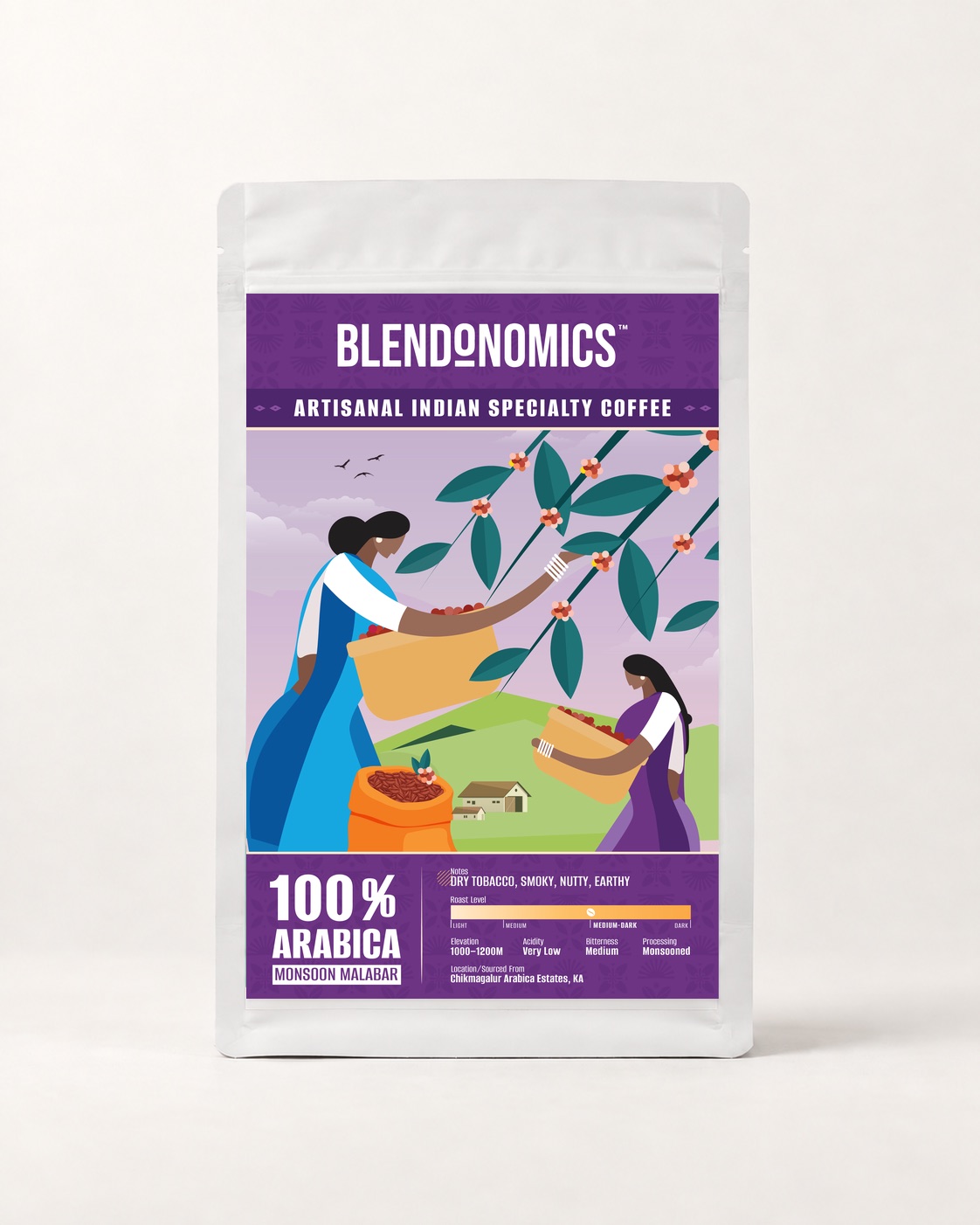
Ours is here: Chikmagalur Arabica, monsooned, 250 g for Rs 599. To taste it beside our other single origin, try the single origin sampler. In our books single origin rarely comes back: 0 of 8 accounts since July 2025 (our data).
 On the menuWhy Monsoon Malabar Is the Most Misunderstood Coffee in India5 min read →
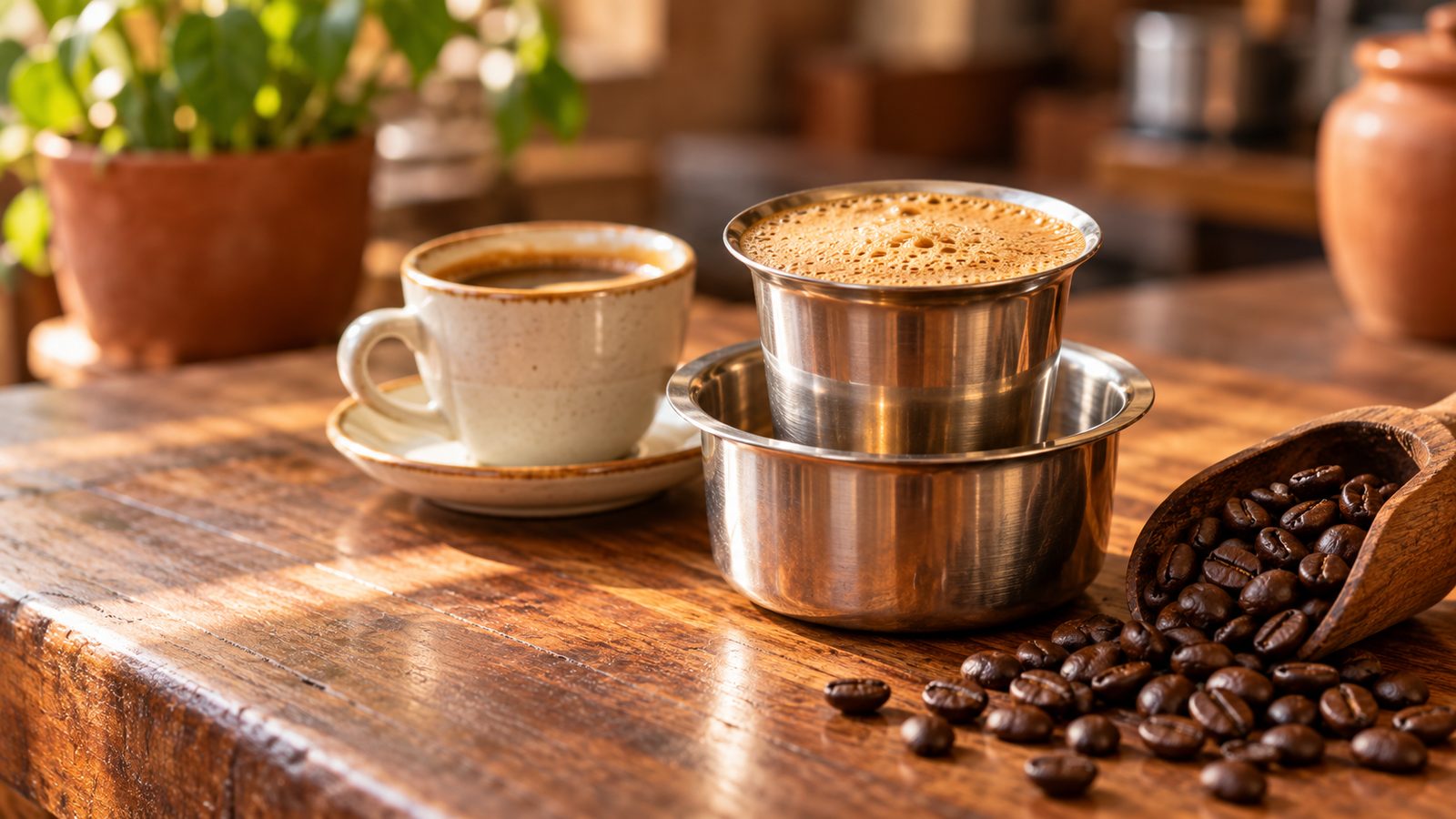 Who drinks whatSpecialty Coffee Grew Up in Delhi, Not Chennai6 min read →
What to do next
- Order a 250 g pack of Monsoon Malabar and taste it black first, then with milk.
- Look at the beans. Pale and swollen is right. Green or brown is not monsooned.
- Ask any supplier for the Coffee Board curing works name and GI details. Both are on record.
- Read the menu use in the earlier article before putting it on a bar.
- Keep an everyday blend as the coffee you pour daily.
The sea made the taste. The coast made it again. The record only starts with the coast.
Sources
- Wikipedia, Monsooned Malabar (history, process, GI notes; the history sentence on arriving beans is tagged "citation needed")
- Bibliotheque nationale de France, The Suez canal (opening and distances: Marseille to Bombay 10,424 and 4,553 nautical miles, London to Bombay 10,721 and 6,260)
- Wikipedia, Suez Canal (official opening 17 November 1869)
- Crucible, The Magic of Monsooned Malabar (curing works at Calicut 1862, Pierce Leslie; exposure 12 to 16 weeks and 3 to 4 months; grades; moisture 13 to 14.5%; markets; output 3,500 to 5,000 tons; undated reprint)
- Barista Magazine, Understanding the Process: Monsoon Coffee (layers 4 to 6 inches; moisture about 14.5% against 10.5%; 12 to 16 weeks; roast note)
- Inter-American Coffee, The Happy Accident of India Monsooned Malabar (4 to 6 month voyage, windrows, wet-hulled description, 3 December 2018)
- Rave Coffee, A Short History of Monsooning (late 19th to early 20th century land monsooning)
- India GI Registry, Monsooned Malabar Arabica Coffee, application 85 (filed 5 April 2007, certificate 28 March 2008, valid to 4 April 2027; area Karnataka and Kerala). No working link found; search the registry by application number.
- India GI Registry, Monsooned Malabar Robusta Coffee, application 114 (filed 12 October 2007, certificate 28 March 2008). No working link found; search the registry by application number.
- OEC, Coffee in India Trade (2024 export destinations)
- Coffee Board of India, Speciality Coffee page (Monsooned Malabar AA: dry processed Arabica and Robusta only, 12 to 16 weeks, nearly double size, "centuries ago" sailing ship history, use in blends; Mysore Nuggets Extra Bold cup)
- Blendonomics journal: Why Monsoon Malabar Is the Most Misunderstood Coffee in India; Specialty Coffee Grew Up in Delhi, Not Chennai. Our own order data (Busy accounts, sales since July 2025, pulled 24 October 2026).
Keep reading
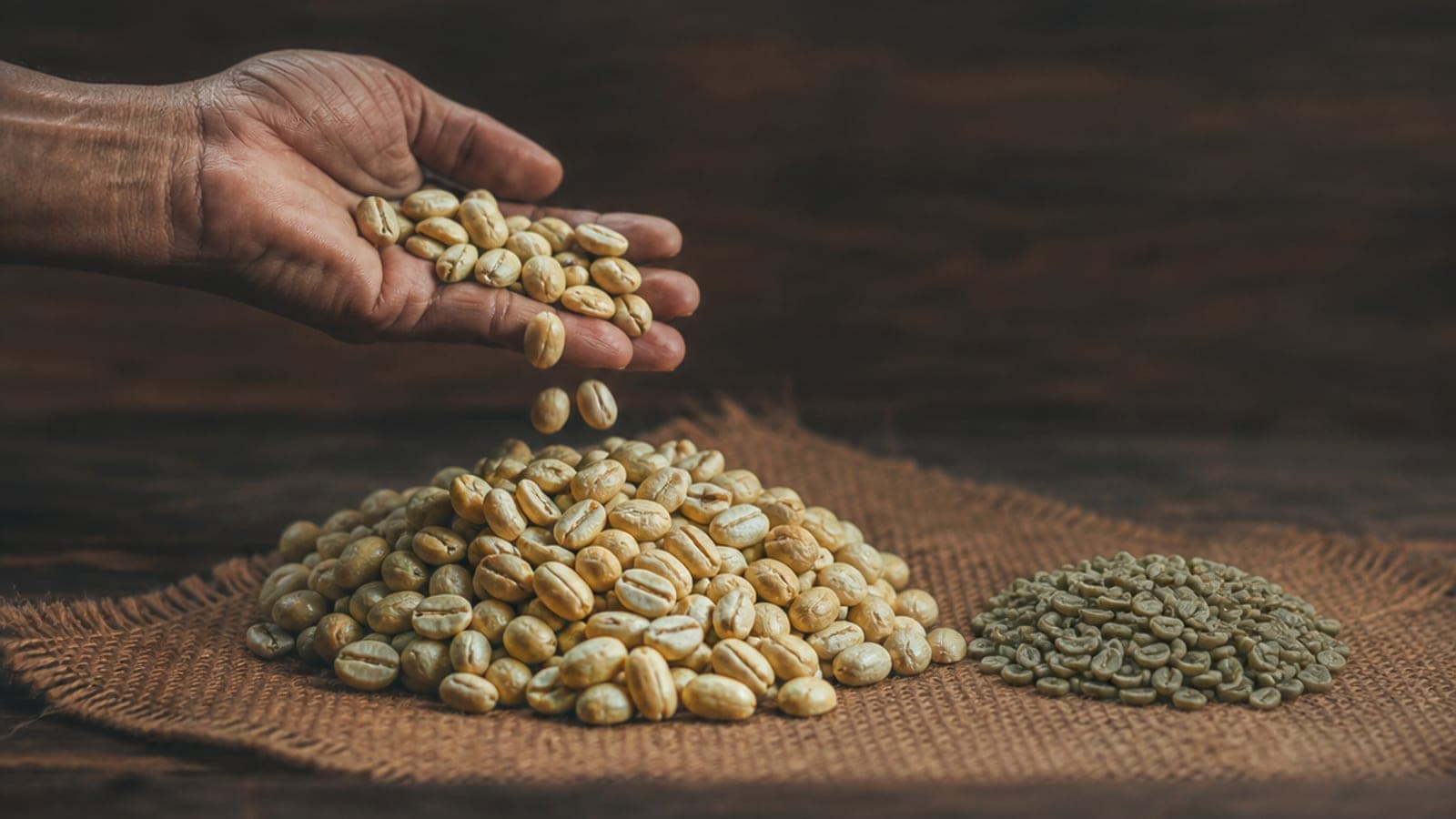
Why Monsoon Malabar Is the Most Misunderstood Coffee in India
The process is older than modern coffee standards. Operators who understand it are building menus most competitors have not caught up with.
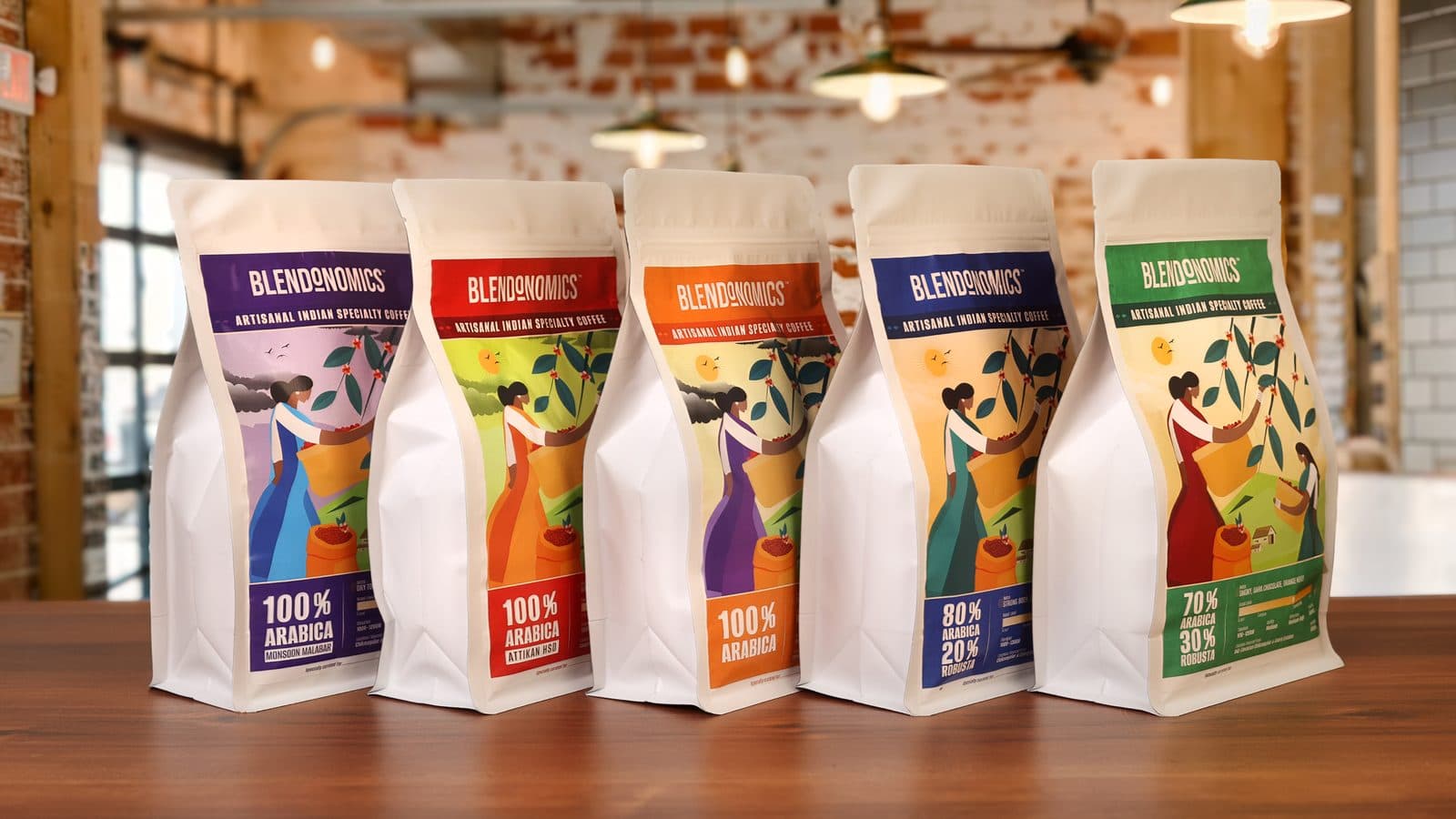
How to Choose Coffee Beans and a Supplier for Your Cafe
A dearer kilo adds about Rs 7 to a cup that sells for Rs 180. Eight questions to ask any coffee supplier, including us, before price.
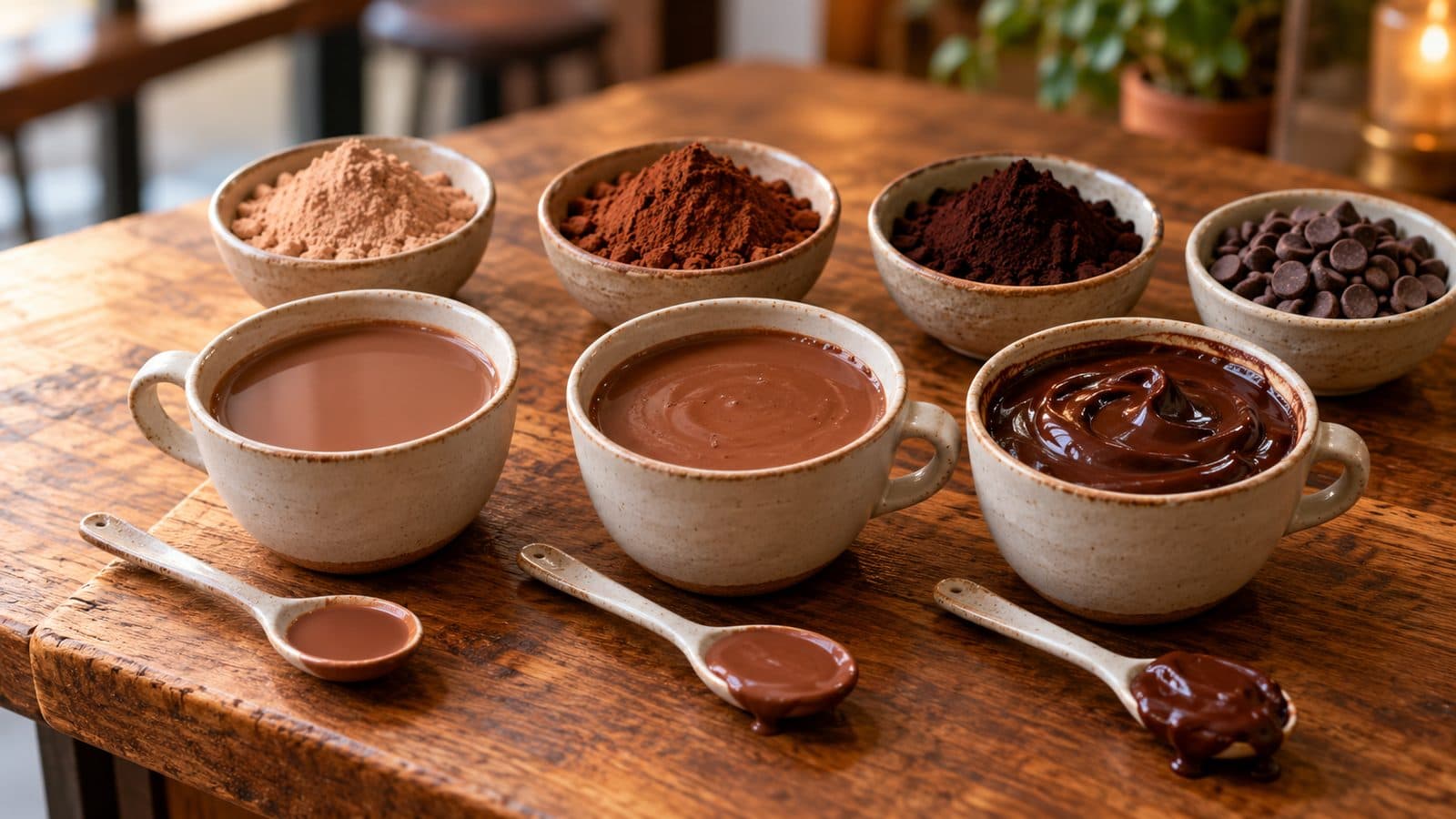
How to Choose a Hot Chocolate Premix for Your Cafe
Price per kilo is the wrong first number. Eight questions to ask any supplier, including us, before you buy.